AI agents built into your healthcare stack
Build AI agents that read clinical and operational context, complete controlled actions, verify outcomes, and escalate exceptions across your existing healthcare systems.
- FHIR
- HL7
- EHR / PMS integrations
- HIPAA
- ISO 27001
Trusted by healthcare teams in the US and Europe since 2016
Don't add another chatbot. Automate the work.
The most valuable healthcare agents work inside real workflows, where staff still check portals, copy data between systems, chase missing information, and follow up by hand. We build agents around those jobs.
Isolated chatbot
Answers questions in a window. Staff still do the work in the EHR, PMS, and payer portals.
Agent inside the workflow
Reads the systems, does the task, verifies the result, and hands only exceptions to staff.
-
Patient access
Patient intakeEligibility verificationScheduling & reschedulingReferral intakeInsurance verificationPatient outreach
-
Revenue cycle
Prior authorizationClaims status checksDenial triageCoding supportPayment follow-up
-
Clinical operations
Documentation workflowsCare coordinationPost-visit follow-upRPM exception handlingChart preparationResults communication
-
Back office
Inbox routingDocument processingOperational reconciliationCredentialing supportRepetitive data entry
From trigger to action, not prompt to response
- TriggerReferral received, appointment booked, claim changed
- ContextEHR · PMS · RCM · CRM · payer portal · documents
- Agent reasoningInterpret, classify, decide, prepare
- ActionUpdate, submit, schedule, route, communicate
- VerificationConfirm the outcome
- EscalationSend exceptions to the right person
A useful healthcare agent needs more than a model: access to the right systems, clear permissions, reliable actions, verification, observability, and human fallback.
Healthcare AI agents we can build
-
Eligibility verification agent
- Visit booked
- Check payer
- Update PMS
- Flag change
Checks coverage before appointments, detects expired or changed plans, updates records, and routes exceptions to staff.
ValueFewer unpaid visits and fewer manual checks
-
Prior authorization agent
- Order
- Assemble docs
- Submit
- Track
Collects required information, prepares submissions, checks status, and escalates missing documentation.
ValueLess portal chasing, shorter turnaround
-
Referral management agent
- Fax / eReferral
- Extract
- Validate
- Create
Reads referrals, extracts patient and clinical data, validates requirements, creates records, and routes the referral.
ValueSmaller backlog, faster time to appointment
-
Scheduling agent
- Request
- Find slot
- Book
- Confirm
Handles booking, rescheduling, cancellations, waitlists, and patient outreach against real availability.
ValueBetter utilization, lighter front desk
-
Claims follow-up agent
- Remit
- Compare
- Draft action
- Route
Monitors claim status, identifies denials or underpayments, prepares follow-up actions, and routes complex cases.
ValueRevenue recovered without reviewing every claim
-
Clinical intake agent
- Invite
- Collect
- Structure
- Chart
Collects medical history and structured pre-visit information before the appointment and writes it to the chart.
ValueLess visit time spent gathering routine context
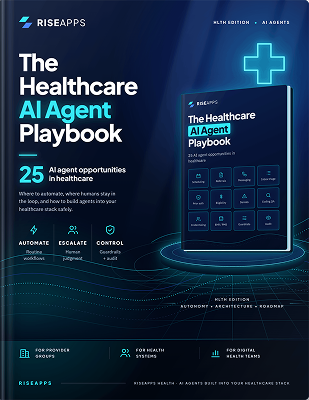
Explore 25 healthcare AI agent opportunities
The full catalog behind this page: 25 agents with frameworks for autonomy, integrations, risk, ROI, and moving from workflow selection to production.
Your agent is only useful if it can work with your systems
We build the integration layer that lets agents safely read context, perform actions, and write data back into existing healthcare systems.
AI agent layer
Eligibility agentPrior auth agentReferral agentScheduling agentClaims agentIntake agent
Riseapps integration & control layer
IdentityPermissionsFHIR / HL7Vendor APIsData transformationRetriesVerificationAudit trailMonitoring
Healthcare systems
EHRPMSRCMPayer systemsLabsImagingCRMLegacy systems
Epic · athenahealth · eClinicalWorks · Oracle Health · NextGen
Not every workflow should run fully autonomously
-
Assist
The agent prepares information or recommendations.
Human decides
-
Execute with review
The agent completes the task and requests approval for sensitive actions.
Human stays in the loop
-
Autonomous within guardrails
The agent completes defined low-risk workflows on its own and escalates exceptions.
Human handles edge cases
We design autonomy around workflow risk, not around what the model is technically capable of doing.
Production AI requires healthcare engineering
- Healthcare workflowsWe map the operational job before choosing the AI architecture.
- IntegrationsAgents connect to EHRs, PMS, RCM, payer platforms, devices, and legacy systems.
- GovernancePermissions, escalation, auditability, and observability are designed in from the start.
- DataWe normalize fragmented healthcare data so agents work from reliable context.
AI and automation already in production
Clinical and operational AI we have shipped, with the outcomes our clients measured.
- AI on clinical data
4h → 30m
to prepare a Medicare-compliant care plan
- Problem
- Clinicians spent hours assembling care plans for dementia patients.
- Built
- AI care-plan copilot with clinician approval of every plan
- Systems
- EHR + ambient visit data
- RPM exception handling
+77%
patient adherence
- Problem
- Care teams could not keep up with remote patients between visits.
- Built
- RPM module with real-time vitals, alerts, and clinician queues
- Systems
- Devices + care-team alerts
- Clinical workflows
+34%
wound healing ratio
- Problem
- Field operations for a Medicare Part B wound-care provider ran on spreadsheets and an MVP.
- Built
- AI-powered wound-care platform with 120+ workflow modules
- Systems
- Clinician app · billing · reporting
After partnering with Riseapps, we booked 462 patients, allowing the company to accrue revenue. The quality of their code was commendable.
 Tara RaffiFounder, Almond ObGyn
“We've seen a reduction in bugs and timely delivery.”
 Andrew BellinghamDirector of Product, Healthera
 Simon Liu, HealtheraWatch the video testimonial(opens in a new tab)
From workflow to production
-
1Map the job
Who does it today, which systems they touch, where time is lost.
-
2Define autonomy
What the agent can do, what needs review, what must escalate.
-
3Connect the systems
APIs, EHRs, portals, data sources, and write-back.
-
4Build and validate
Agent logic, tools, guardrails, and exception paths.
-
5Deploy and monitor
Performance, failures, escalation rates, and operational ROI.
Healthcare AI agents, answered
What is a healthcare AI agent, and how is it different from a chatbot?
A chatbot answers questions. A healthcare AI agent completes a job: it reads context from your systems, takes controlled actions such as updating a record or submitting a request, checks that the action worked, and hands exceptions to staff.
Which workflows should we automate with agents first?
Start with high-volume, rules-heavy work with low clinical risk and clear success criteria: eligibility checks, scheduling and rescheduling, referral intake, claims status checks, and document processing.
Can agents work inside our EHR and PMS?
Yes. Agents read and write through FHIR, HL7, and vendor APIs for systems such as Epic, athenahealth, eClinicalWorks, Oracle Health, and NextGen. Where APIs fall short, we design file-based, database, or other fallback paths and isolate them from the agent logic.
How do you keep agents safe and compliant?
Each agent runs with role-based permissions, defined autonomy limits, human approval for sensitive actions, verification against the source system, a full audit trail, and production monitoring, on infrastructure that meets HIPAA and GDPR requirements.
Which AI models do you use?
We are model-agnostic and choose per task, balancing accuracy, latency, cost, and data-handling requirements, including providers that sign a BAA or models deployed in your own cloud.
How do we measure ROI from an agent?
We baseline the workflow before go-live and track manual touches per task, minutes per transaction, turnaround time, escalation rate, and the revenue or capacity effect, such as fewer unpaid visits or faster authorizations.
What work should your team stop doing manually?
Tell us the workflow, the systems involved, and where the bottleneck is. We'll map what an AI agent could safely take over.
- Free 30-minute call with our CTO
- Architects who know EHR, PMS, and RCM systems
- NDA on request
Email biz@riseapps.biz