Turning a Clinical AI Research Model Into an MDR-Ready Platform Deployed Across European Hospitals
AI
Healthcare
AI consulting
Engineering
Up to 50%
of high-risk elderly surgical patients develop postoperative delirium
$150B+
estimated annual cost of delirium to the healthcare system (Leslie et al.)
About client
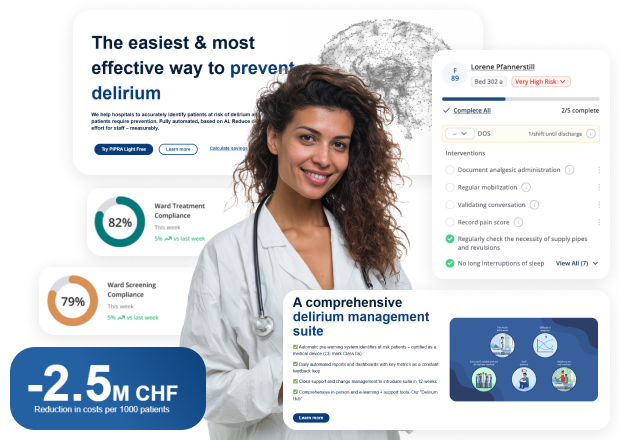
The client is a European MedTech company (Swiss-founded) with a clinically validated breakthrough: an AI model that predicts which elderly surgical patients are at risk of postoperative delirium - a common, dangerous, and largely preventable complication. In hospital trials, their model had already demonstrated a 29% reduction in delirium incidence. The science worked.
The problem was that science alone doesn't reach patients. Their technology existed as a research prototype - accurate, published, but not deployable. When they secured a multi-country EU research grant to validate the model across four European hospitals, they hit the wall every clinical-AI research team eventually hits: a validated model is not a product, and a grant deadline is a hard commercial deadline.
They came to Riseapps to close that gap - to turn a research model into a certified, hospital-ready platform, integrated into real clinical environments, before the funding window closed.
What the client set out to achieve:
- Productize their AI research model into a clinical-grade SaaS platform
- Integrate in real time with hospital systems across four EU countries
- Build infrastructure compliant with EU MDR and GDPR from the ground up
- Design an interface clinicians would actually adopt inside their existing workflo
The problem was that science alone doesn't reach patients. Their technology existed as a research prototype - accurate, published, but not deployable. When they secured a multi-country EU research grant to validate the model across four European hospitals, they hit the wall every clinical-AI research team eventually hits: a validated model is not a product, and a grant deadline is a hard commercial deadline.
They came to Riseapps to close that gap - to turn a research model into a certified, hospital-ready platform, integrated into real clinical environments, before the funding window closed.
What the client set out to achieve:
- Productize their AI research model into a clinical-grade SaaS platform
- Integrate in real time with hospital systems across four EU countries
- Build infrastructure compliant with EU MDR and GDPR from the ground up
- Design an interface clinicians would actually adopt inside their existing workflo
4 EU hospitals
Integrated for the multi-country validation pilot
< 6 months
From research prototype to MDR-ready SaaS platform
70% faster
Hospital onboarding time via modular integrations
10–15 clinicians
Involved in pilot testing and UI validation sessions
29% reduction
In delirium incidence demonstrated in the client's hospital trials
Up to 50%
Estimated annual cost of delirium to the healthcare system
Why PIPRA reached out to Riseapps
1
A Validated Model Isn't a Product Yet
The hardest part of clinical AI isn't the algorithm - it's everything around it. The client had proof the model worked, but no authentication, no audit trails, no logging, no deployable infrastructure. Turning research code into software a hospital can run in a regulated environment is a different discipline entirely, and it was the gap standing between validated science and clinical impact.
2
Every Hospital Is a Different Integration Problem
Scaling across four hospitals meant scaling across four IT ecosystems - different EHR systems (SAP, Epic, and regional providers), different data formats, different integration constraints. Without a strategy for this, each new hospital becomes a bespoke, weeks-long engineering project - and a growth ceiling. Integration wasn't a technical detail; it was the thing that determined whether the platform could scale at all.
3
Without MDR Certification, the Technology Can't Legally Reach Patients
In Europe, clinical software that informs care decisions falls under EU MDR. No compliant, auditable infrastructure means no certification - and no certification means the technology stays in the lab regardless of how well it performs. Regulatory readiness was a market-access requirement, not a checkbox.
4
The Grant Clock Was a Commercial Deadline
EU research grants come with fixed timelines and funding penalties for missing them. The client couldn't afford a long build cycle, and they couldn't afford to pull their small research team off the science to manage software delivery. They needed production-grade software delivered fast, without slowing research operations.
Delivered solutions
A Certification-Ready Clinical AI Platform
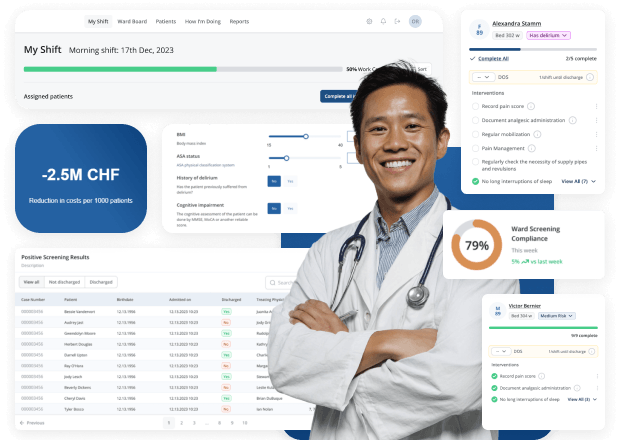
We transformed the research prototype into a commercial, hospital-ready web platform - adding the authentication, logging, and audit trails that regulated clinical deployment requires. The model went from validated research code to software a hospital compliance team could actually approve for use.
Impact: Enabled clinical deployment in regulated hospital environments and laid the compliant foundation for CE certification.
Impact: Enabled clinical deployment in regulated hospital environments and laid the compliant foundation for CE certification.
A Modular Integration Layer (FHIR / HL7 / CSV)
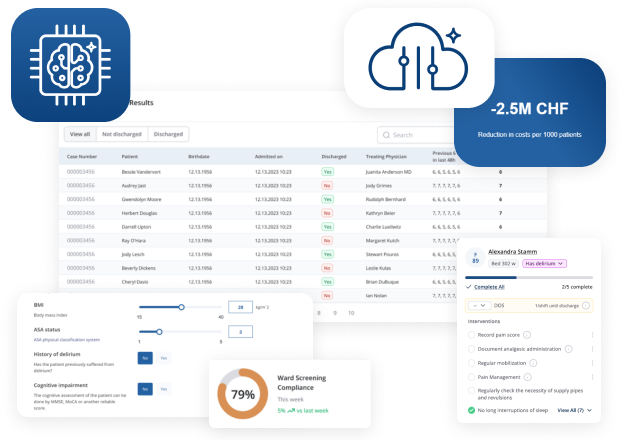
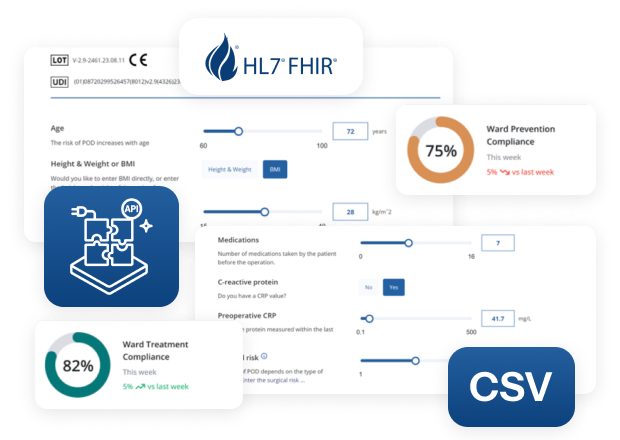
Rather than building a one-off connector per hospital, we built a flexible integration layer that adapts to varied hospital IT ecosystems - so the platform connects to multiple EHR formats through a standardized data-exchange architecture instead of bespoke engineering each time.
Impact: Reduced hospital onboarding from weeks to days — turning integration from a growth ceiling into a repeatable process.
Impact: Reduced hospital onboarding from weeks to days — turning integration from a growth ceiling into a repeatable process.
Secure, GDPR-Compliant Cloud Infrastructure
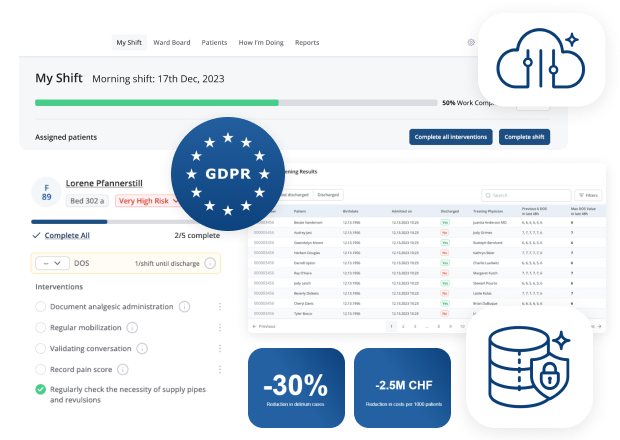
We deployed a secure cloud environment with per-hospital data isolation, so each institution's patient data stays contained and compliant. Infrastructure management was simplified while meeting the regulatory bar for handling sensitive clinical data.
Impact: Ensured regulatory safety for sensitive patient data and made multi-hospital deployment manageable for a small team.
Impact: Ensured regulatory safety for sensitive patient data and made multi-hospital deployment manageable for a small team.
A Clinician-Centered Interface
We redesigned the interface around clinical decision-making, not data entry - risk visualizations and one-screen patient summaries that give a clinician what they need at a glance, inside the pressure of a real perioperative workflow. Adoption depends on fit, and fit was designed in, validated with 10–15 clinicians in pilot testing.
Impact: Improved usability and increased clinician adoption during the pilot phase.
Impact: Improved usability and increased clinician adoption during the pilot phase.
Achieved results
The results
4 hospitals
Four European hospitals were integrated through standardized HL7/FHIR connections and secure deployment - the multi-country validation footprint the grant required, delivered on schedule.

MDR-Ready SaaS
The research prototype became a compliant, production-grade SaaS platform in under six months - ready for clinical validation and CE certification, without pulling the research team off the science.

70% faster
The modular data-exchange architecture cut hospital integration time from weeks to days - turning what would have been the platform's biggest scaling bottleneck into a repeatable onboarding process.
Book a live demo to see it in action
RELEVANT CASES
Check our more healthcare stories
AI-powered athletic footwear solution for professional athletes
6
Months to MVP release
Strava & Nike
EU competitor
Growing patient acquisition and revenue in virtual OB-GYN care
462
New patients acquired
$7M funding
Raised to scale nationwide
Cutting care delivery costs by 40% with AI-driven virtual-first healthcare
96% reduction
In cardiovascular disease amputations
Contact Us
Please provide your info and inquiry details below.