Replacing an ECW Healow patient app to scale nationally for a women's health group
AI
Healthcare
EHR Integration
Engineering
89%
of patients expect online self-scheduling, but only 11% practices deliver it
About the client
The client is a 20-year-old NY-based women's health practice built on a strong clinical brand across OB/GYN, reproductive health, and preventive care. With national expansion underway, they reached an inflection point that most growing practices hit eventually: the digital infrastructure that got them here couldn't take them where they needed to go.
Their EHR of record was eClinicalWorks. Their patient-facing layer was a third-party mobile app that handled portal access, messaging, and appointment booking - the kind of platform that looks adequate on a vendor slide deck but reveals its limits the moment you try to modify it. After years of working around its constraints, the leadership team made a decision: stop patching it, replace it entirely with something they actually owned.
The goal wasn't to build another portal. It was to build the digital foundation for a national healthcare brand - one that could handle geographic expansion, enable new revenue streams, and give operations full control without waiting on a vendor's product roadmap.
Their EHR of record was eClinicalWorks. Their patient-facing layer was a third-party mobile app that handled portal access, messaging, and appointment booking - the kind of platform that looks adequate on a vendor slide deck but reveals its limits the moment you try to modify it. After years of working around its constraints, the leadership team made a decision: stop patching it, replace it entirely with something they actually owned.
The goal wasn't to build another portal. It was to build the digital foundation for a national healthcare brand - one that could handle geographic expansion, enable new revenue streams, and give operations full control without waiting on a vendor's product roadmap.
Location
United States
EHR
eClinicalWorks (ECW)
Compliance
HIPAA
Platform
iOS, Android, Web
Delivery
Portal → Admin Backend → Partnership Integrations
The challenges
1
Current mobile patient app was a revenue blocker
The third-party platform the practice had relied on was designed as a generic patient communication tool. It couldn't support partnership integrations for specialty testing. It couldn't accommodate custom billing logic needed for payer relationships. And it offered no meaningful customization for different market contexts. Every new revenue initiative ran into the same wall
2
No control over the patient experience
The practice had no backend access to configure the patient journey, modify workflows by location, or adapt features to different state markets. Changes required submitting requests to the vendor and waiting. For a 20-year brand expanding nationally, depending on a vendor's release schedule for basic operational decisions wasn't a strategy. It was a constraint dressed up as a platform.
3
Patient onboarding was fragmented and leaky
The path from first contact to booked appointment was full of unnecessary friction: disconnected steps, unclear account states, and no logic connecting a prospective patient's location to the right provider, service, or market. The result was patients who started the flow but never completed it - bookings lost silently, with no visibility into where the drop-off was happening.
4
Vendor lock-in scaling issues
When the practice began exploring a rebuild, they discovered the existing app was far more complex than the vendor had represented - layered authentication mechanisms, undocumented dependencies, and no clear map of what could be reused versus rebuilt. Several vendors had proposed building on top of it without auditing what they were inheriting. That path would have reproduced the same constraints at higher cost.
What we built
Customized mobile patient experience
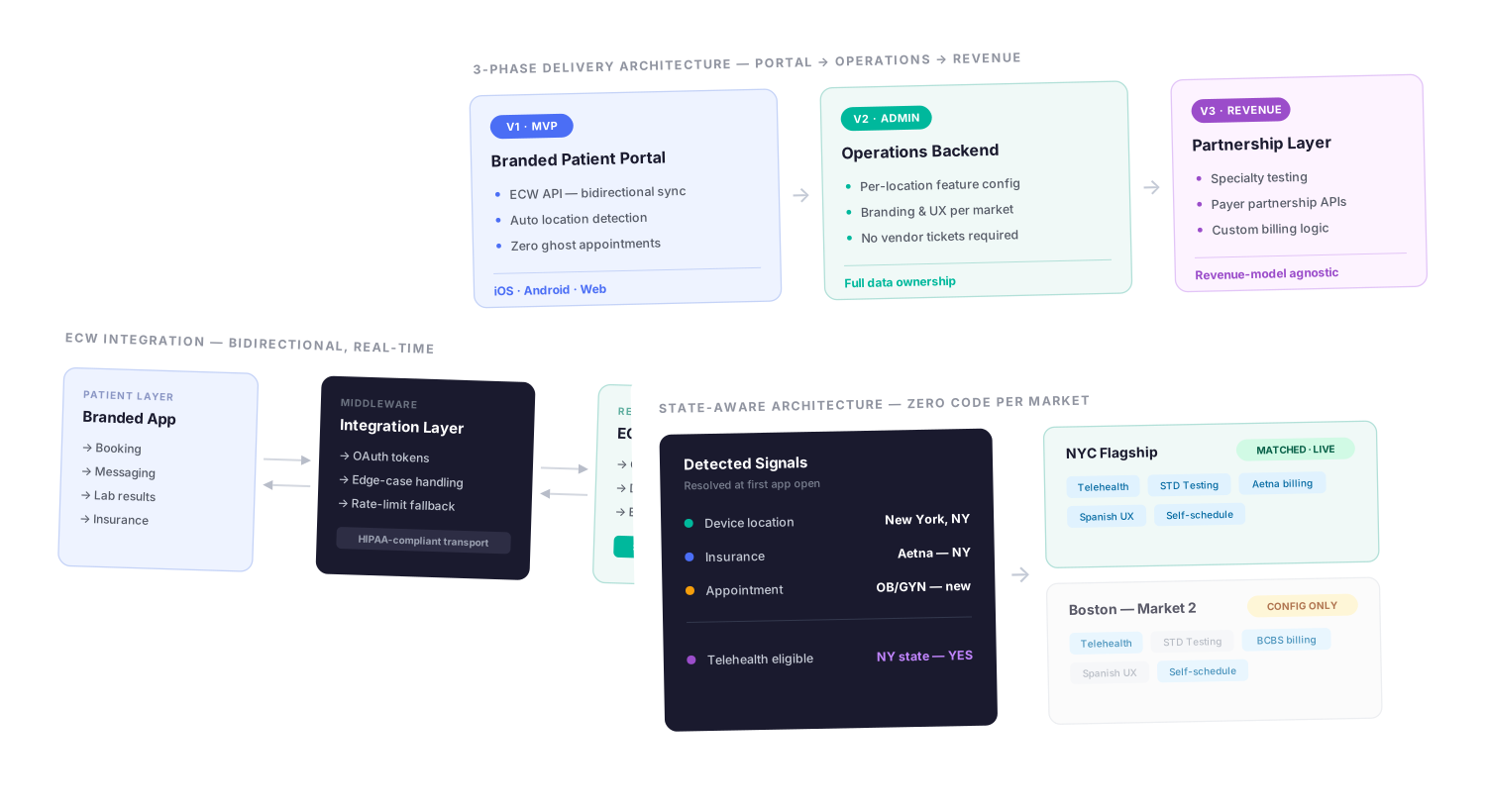
Branded Patient Portal (MVP): The core patient journey rebuilt from scratch on ECW APIs. Location detection routes patients to the right market automatically. Onboarding runs as a single connected sequence - name, DOB, location, provider match, portal access — with no dead ends, no accounts stuck in limbo, no ghost appointments.
Admin Backend for Full Operational Control: The backend the practice never had. Operations can configure features, adjust workflows, modify branding, and manage patient experience settings per location - without a vendor ticket. Patient data is theirs: accessible, exportable, under direct control.
Revenue and Partnership Layer: The commercial infrastructure the old platform structurally couldn't support. Specialty testing integrations, payer partnership APIs, custom billing logic - each revenue model gets its own integration path, built cleanly and extensible as new partnerships come online.
Admin Backend for Full Operational Control: The backend the practice never had. Operations can configure features, adjust workflows, modify branding, and manage patient experience settings per location - without a vendor ticket. Patient data is theirs: accessible, exportable, under direct control.
Revenue and Partnership Layer: The commercial infrastructure the old platform structurally couldn't support. Specialty testing integrations, payer partnership APIs, custom billing logic - each revenue model gets its own integration path, built cleanly and extensible as new partnerships come online.
eClinicalWorks integration that works under the hood
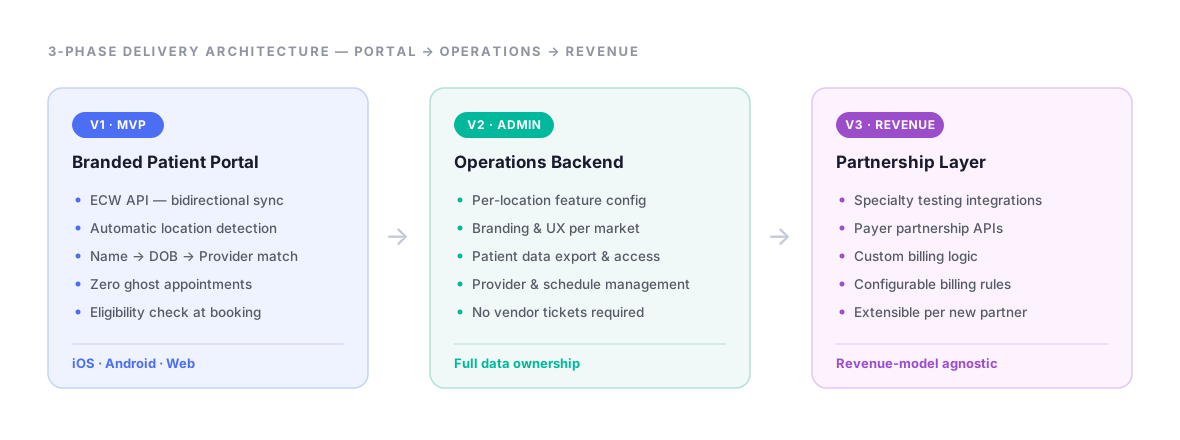
eClinicalWorks has an API. Integrating it correctly for a multi-location practice - with complex scheduling rules, insurance eligibility logic, and revenue cycle workflows - requires engineers who have done it before.
We mapped the full integration surface before writing product code: what lives in ECW vs. the custom layer, how bidirectional sync handles edge cases (cancellations, eligibility failures, no-shows), and what graceful degradation looks like when API limits are hit. The front desk sees one unified schedule. Patients see accurate availability. Neither group manages the gap between two systems.
We mapped the full integration surface before writing product code: what lives in ECW vs. the custom layer, how bidirectional sync handles edge cases (cancellations, eligibility failures, no-shows), and what graceful degradation looks like when API limits are hit. The front desk sees one unified schedule. Patients see accurate availability. Neither group manages the gap between two systems.
Location-aware architecture for every new market
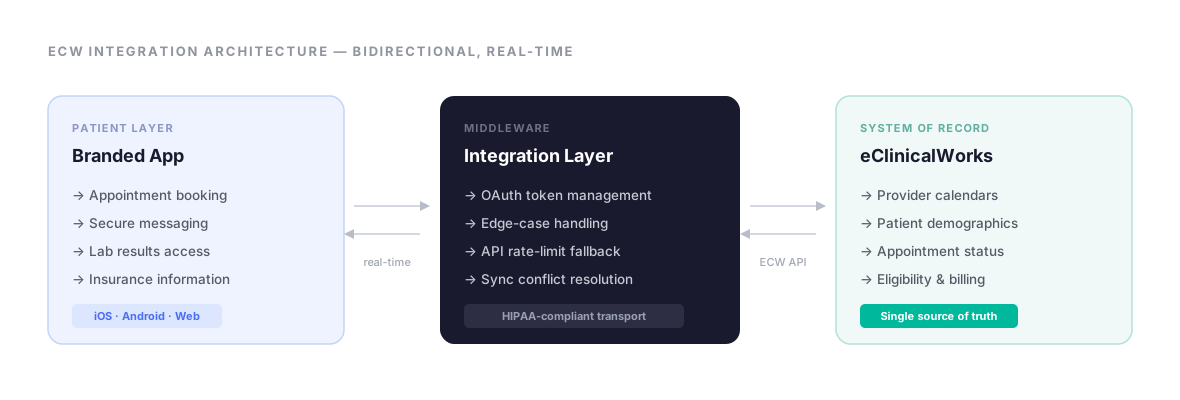
Women's health markets differ - regulatory context, service availability, payer relationships, telehealth rules - and those differences change faster than any vendor's release cycle. A platform designed for one NYC location breaks in non-obvious ways when you enter a new state.
State-aware geography is built into the platform core: automatic location detection routes patients to the right market context from first contact. Features, branding, service availability, and billing configuration are toggled per location from the admin backend. Adding a new state market is a configuration exercise, not a development sprint.
State-aware geography is built into the platform core: automatic location detection routes patients to the right market context from first contact. Features, branding, service availability, and billing configuration are toggled per location from the admin backend. Adding a new state market is a configuration exercise, not a development sprint.
Achieved results
The results
100% patient experience ownership
The practice moved from a vendor-dependent app they couldn't configure to a platform they control entirely. Patient data, administrative functionality, and the feature roadmap are internal decisions now.
New revenue streams that were locked before
With the partnership layer live, the practice can activate payer relationships, specialty testing services, and custom billing models that the previous platform couldn't support by design. The commercial infrastructure is in place for national expansion.
Visibility of workflow analytics and patient experience
With a vendor-controlled app, the practice had no access to behavioral data: no funnel analytics, no drop-off tracking, no way to know whether onboarding friction was losing patients. The custom platform gave them owned data for the first time - including exactly the ghost appointment problem reasons, the lowest completion rates across segments, and more.
Book a live demo to see it in action
RELEVANT CASES
Check our more healthcare stories
AI-powered athletic footwear solution for professional athletes
6
Months to MVP release
Strava & Nike
EU competitor
Growing patient acquisition and revenue in virtual OB-GYN care
462
New patients acquired
$7M funding
Raised to scale nationwide
Cutting care delivery costs by 40% with AI-driven virtual-first healthcare
96% reduction
In cardiovascular disease amputations
Contact Us
Please provide your info and inquiry details below.