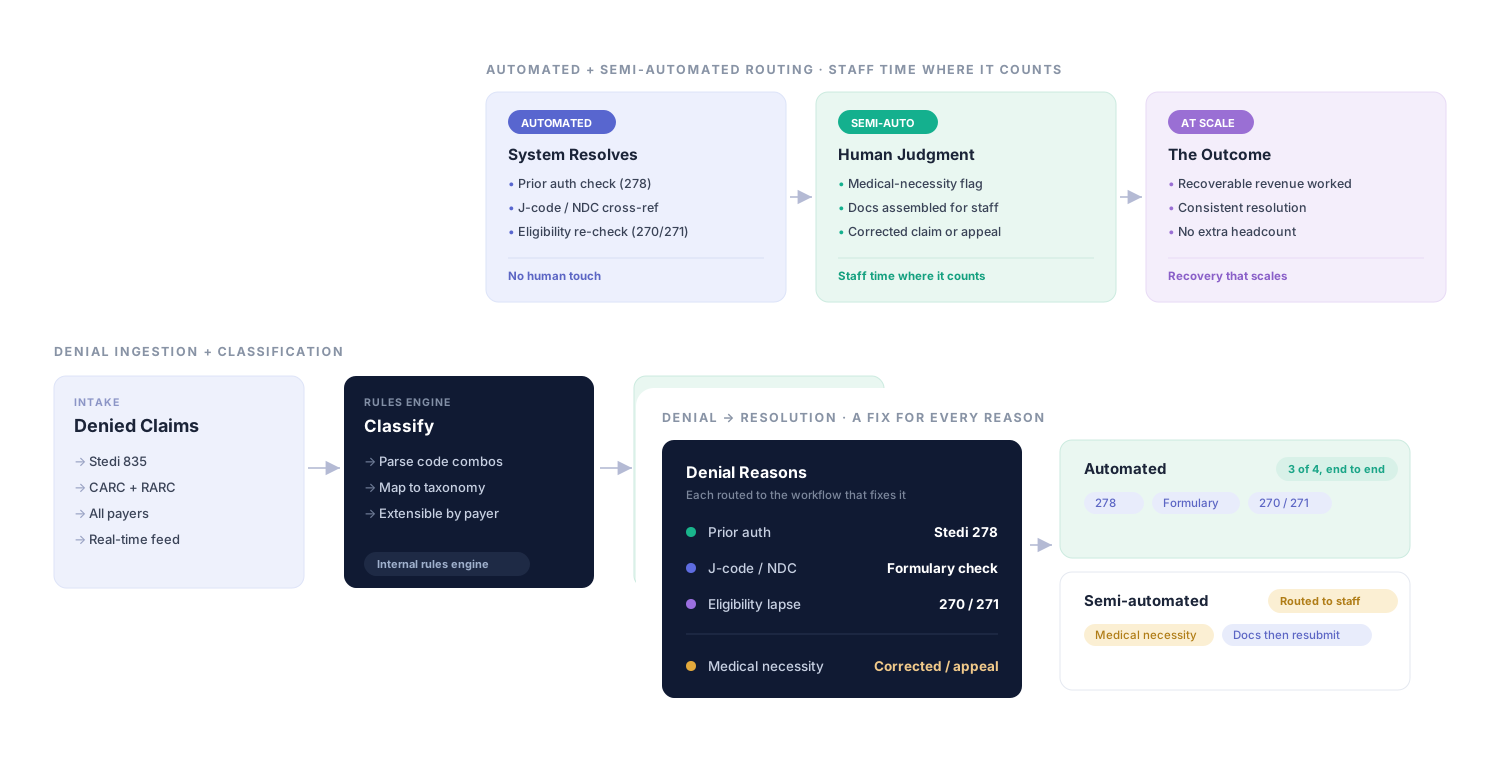
Turning denied infusion claims into recovered revenue with an automated denial-management pipeline
Healthcare
EHR Integration
Engineering
65%
of denied claims are never resubmitted, recoverable revenue lost to manual rework capacity, not to unrecoverable claims
BACKGROUND
About the client
The client is a chain of oncology infusion centers, delivering infusion therapy across multiple sites in a corner of healthcare billing that is far more complex and far more denial-prone than general outpatient care. They were leaving real money on the table, and not because the claims were lost causes.
The pattern was consistent: denied claims piled up faster than their billing team could work them. Most were recoverable, a lapsed authorization here, a code mismatch there, but recovering each one takes time, and manual rework capacity simply could not keep up with the volume. Revenue that should have been collected was quietly written off because no one had the hours to chase it.
They came to us to fix the bottleneck at its source, inside their own revenue-cycle platform: an automated denial-management pipeline that ingests every denied claim, identifies exactly why it was denied, and routes it down the right resolution path, so recoverable revenue stops slipping through for want of manual capacity.
The pattern was consistent: denied claims piled up faster than their billing team could work them. Most were recoverable, a lapsed authorization here, a code mismatch there, but recovering each one takes time, and manual rework capacity simply could not keep up with the volume. Revenue that should have been collected was quietly written off because no one had the hours to chase it.
They came to us to fix the bottleneck at its source, inside their own revenue-cycle platform: an automated denial-management pipeline that ingests every denied claim, identifies exactly why it was denied, and routes it down the right resolution path, so recoverable revenue stops slipping through for want of manual capacity.
Domain
Oncology infusion centers
Compliance
HIPAA
Platform
Web
Integrations
Stedi: 835, 837, 278, 270/271
Tech stack
Node.js, PostgreSQL (Supabase), internal rules engine
The challenges
1
Infusion billing is uniquely complex
Every infusion claim carries a drug component (a J-code mapped to an NDC), an administration component (the CPT 96365 to 96417 series), and often a prior authorization that varies by payer and by drug. Three moving parts on every claim, each with its own way to fail, is what makes this domain so denial-prone.
2
Denials come from many different triggers
Lapsed prior auth, a J-code that does not match the payer formulary for its NDC, incorrect administration-code sequencing (initial versus subsequent hour), medical-necessity documentation gaps, and eligibility lapses between scheduled sessions. Each trigger needs a different fix, so there is no single resolution that works for all of them.
3
Manual rework capacity could not keep up
The revenue was recoverable; the hours were not there to recover it. As claim volume grew, the gap between denials received and denials worked widened, and recoverable dollars were written off by default rather than by decision.
4
Classification was the real bottleneck
Before anyone can fix a denial, they have to read the CARC and RARC reason codes and decide what actually went wrong. Done by hand across thousands of claims, that triage step alone consumed the capacity that should have gone into resolution and resubmission.
What we built
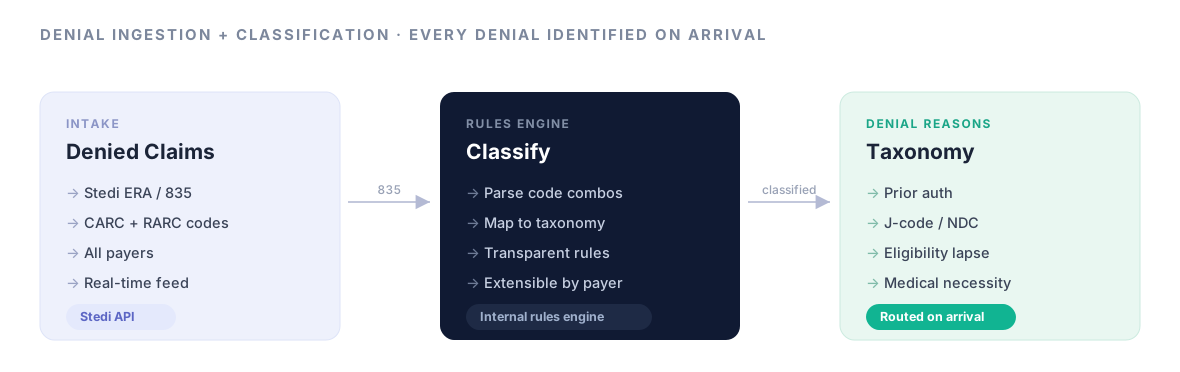
Denial ingestion and code-based classification
Denied claims flow back automatically through Stedi's ERA / 835 endpoint. The system parses each CARC and RARC reason-code combination and maps it to a defined taxonomy of denial reasons, so every denial is identified the moment it arrives instead of waiting in a queue for a human to triage it. An internal rules engine owns the classification and routing logic, which keeps it transparent and easy to extend as new payer behaviors appear.
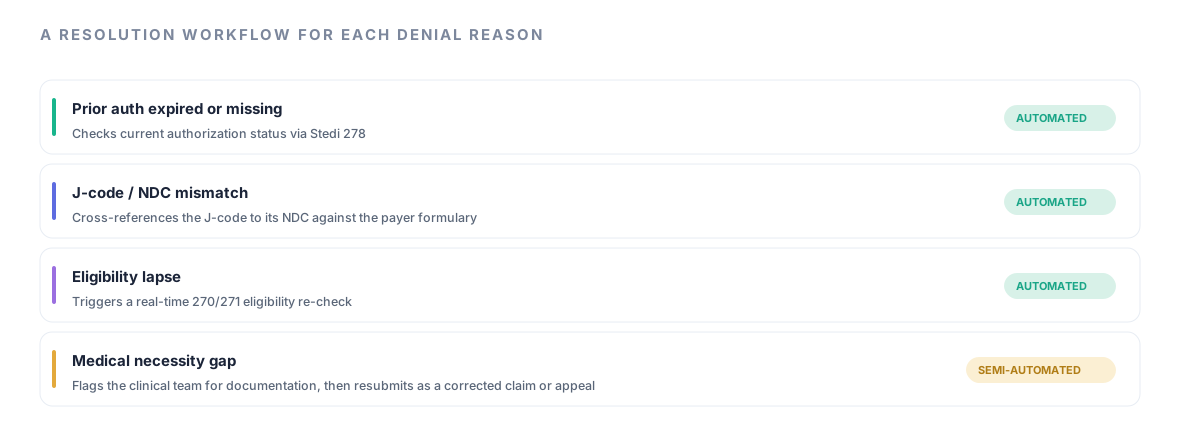
A resolution workflow for each denial reason
Each denial type is routed to the workflow that actually fixes it.
Prior auth expired or missing: the system checks current authorization status through Stedi's 278 endpoint.
J-code / NDC mismatch: it cross-references the J-code to its NDC relation against the payer formulary.
Eligibility lapse: it triggers a real-time 270/271 eligibility re-check.
Medical necessity: it flags the claim for the clinical team to attach supporting documentation, then resubmits it as a corrected claim or a formal appeal.
Prior auth expired or missing: the system checks current authorization status through Stedi's 278 endpoint.
J-code / NDC mismatch: it cross-references the J-code to its NDC relation against the payer formulary.
Eligibility lapse: it triggers a real-time 270/271 eligibility re-check.
Medical necessity: it flags the claim for the clinical team to attach supporting documentation, then resubmits it as a corrected claim or a formal appeal.
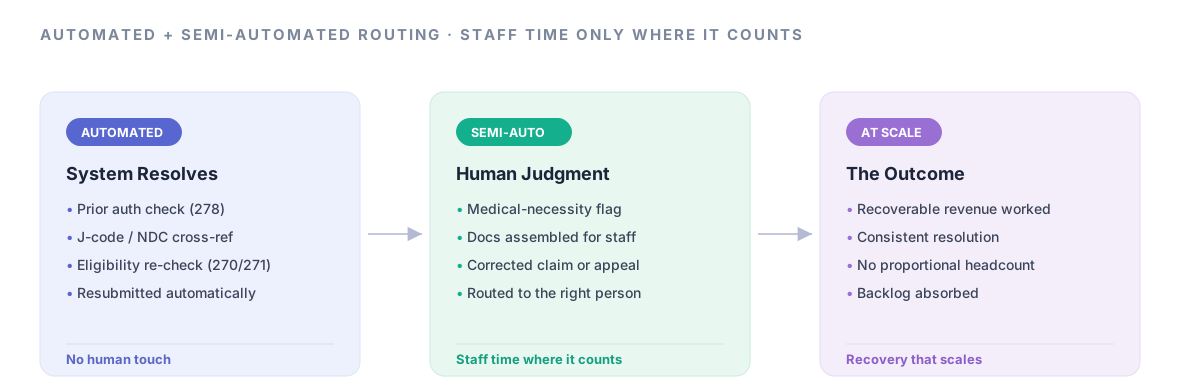
Automated and semi-automated routing
Where a denial can be resolved by data the system can fetch and verify itself, it runs end to end automatically. Where a human judgment is genuinely required, such as attaching clinical documentation for medical necessity, it routes the claim to the right person with everything they need already assembled. The result is that staff time goes to the handful of claims that truly need it, not to triaging every one. Built on Node.js with PostgreSQL on Supabase.
Achieved results
The results
Recoverable revenue stops being written off
Denials that manual capacity could never reach are now classified and routed the moment they arrive, so recoverable dollars get worked instead of quietly lost to the backlog.
Every denial follows a defined, repeatable path
Instead of ad hoc rework, each denial reason has a known resolution, automated where possible, routed to the right person where not, so outcomes are consistent and nothing falls through the cracks.
Recovery that scales with claim volume
Because classification and the data-driven fixes run automatically, growing claim volume no longer demands a proportional increase in billing headcount. Staff focus on the few claims that need human judgment, and the pipeline absorbs the rest.
Book a live demo to see it in action
RELEVANT CASES
Check our more healthcare stories
Scaling a women care clinic with a custom patient platform for eClinicalWorks
3 revenue streams
unlocked with the new patient platform
Cutting care-plan creation from 4 hours to 30 minutes with a validated AI care-plan generator
4h → 30 min
to generate a personalized, clinician-approved care plan
Turning doctor-patient conversations into structured, EHR-ready records with a custom ambient AI scribe
2 hours / day
saved for each clinician with an ambient scribe
Contact Us
Please provide your info and inquiry details below.